Philokalia Ministries
Episodes
May 27, 2026
May 27, 2026
54 min
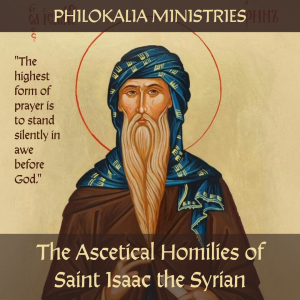
There are passages in the Fathers that do not merely instruct us. They unsettle us because they seem to speak from a place beyond ordinary language. This portion of St. Isaac the Syrian is one of them.
He begins almost defensively, and yet with extraordinary tenderness: “I shall tell you something, and do not laugh, for I speak the truth.” That opening matters. Isaac knows what he is about to describe can sound excessive, mystical, even absurd to the outward or untested mind. He knows some will mock it. Others will reduce it to sentiment or pious exaggeration. He knows he is stepping into something difficult to articulate because the reality itself exceeds words.
And yet he writes.
That itself is striking.
This costs him something.
There is a deeply personal quality here. Isaac is not writing as one giving detached spiritual theory. He writes almost like a father speaking carefully about a mystery he knows language will diminish even as he tries to preserve it. Near the end of the homily he says plainly that he has “taken no little trouble to set these things down.” One feels the labor in that line. Not merely literary labor, but spiritual labor. He is trying to hand on something fragile and luminous to “every man who comes upon this book.” His desire to help souls outweighs the risk of being misunderstood.
And what does he speak of?
Tears.
But not tears as emotional excess.
Not tears as instability.
Not tears as religious theater.
He is speaking of something far deeper: the awakening of the inward man.
Isaac says that until this inward fruit begins, much of our life remains outward. We may pray, labor, fast, study, serve, and yet still remain largely organized around the visible self. The hidden man may still be in service to the world.
Then comes his astonishing image.
When tears begin, the soul has “left the prison of this world.”
Not the world itself.
But its prison.
That inward captivity of self, illusion, hardness, fragmentation, and outwardness.
And then Isaac gives one of the most beautiful images in all ascetical literature: he speaks of the soul almost as an infant being born into another reality.
As an infant in the womb first begins to draw subtle breath before entering this visible life, so the inward man, born of grace through the womb of Mother Church and quickened by the Spirit, begins to perceive another atmosphere.
Another age.
Another reality.
Another air.
He says the soul begins to breathe “that other air, new and wonderful.”
This is breathtaking.
For Isaac, tears are not simply sorrow. They are often the birth pangs of the spiritual child within us. Grace, whom he calls the common mother of all, labors to bring forth the divine image in the soul. And because the mind is unaccustomed to this new reality, the body itself may cry out. Tears become a kind of holy wailing, but “mingled with the sweetness of honey.”
What language.
He is trying to describe something almost impossible: sorrow joined to sweetness, pain joined to grace, birth joined to loss, tears joined to wonder.
The modern mind often has little room for this.
We understand tears psychologically.
We understand grief.
Exhaustion.
Relief.
But Isaac is speaking of something deeper than emotion.
He is speaking of the Kingdom beginning to stir within.
Of the Spirit crying out from depths beyond words.
Of the soul awakening to a reality more real than the visible world.
And yet Isaac remains sober.
He is careful.
He distinguishes passing consolation from deeper compunction. He warns, in effect, against reducing such things to passing feeling or spiritual excitement. He speaks of stillness, of peace of thought, of gradual transition, of hidden maturation. Even here he is restrained.
That restraint matters.
Because what makes this passage so beautiful is not ecstatic excess.
It is tenderness joined to sobriety.
Mystery joined to humility.
Vision joined to caution.
And perhaps most moving of all, Isaac writes not to exalt himself, but to serve.
These things, he says, he has written for himself and for every man who comes upon this book.
That line carries enormous tenderness.
He writes as one who knows words cannot capture the fullness of what grace does, yet he offers them anyway so another soul may not lose courage.
Perhaps that is why this passage still pierces us.
It reminds us that the spiritual life is not merely moral effort, external correctness, or religious performance.
It is birth.
The slow birth of the inward man.
The hidden awakening of the Kingdom.
The Spirit crying from within us.
And perhaps, however faintly, learning to breathe another air.
The air of grace.
The air of the age to come.
The air of Christ.
---
Text of chat during the group:
00:03:13 Fr. Charbel Abernethy: Page 201 Homily 14
There are times in the spiritual life when a phrase begins as an image and slowly becomes a revelation.
For some time now, the phrase Breathing the Same Air has remained with me. At first, it seemed to speak of something many of us deeply long for: to stand among those who thirst for Christ as the Desert Fathers did; to dwell within the same ascetic spirit, the same sobriety, the same inward hunger for purity of heart, prayer, and communion with God.
But after returning to St. Isaac the Syrian, this phrase began to open more deeply.
Perhaps breathing the same air is not first about standing among others who seek God.
Perhaps it is about entering inwardly into the same atmosphere where the saints themselves learned to repent, to pray, to soften, and to become alive before God.
00:10:25 Fr. Charbel Abernethy: June 4 Week Retreat https://www.philokaliaministries.org/post/nazareth-and-the-hidden-life
00:13:45 Fr. Charbel Abernethy: Page 201 Homily 14
00:38:54 una: How is he using "laugh"? In the sense of disbelief?
00:45:04 Bob Čihák, AZ: P 201 second paragraph
00:53:30 Holly Hecker: (From Mark) sometimes I see these attachments (or walls separating from God) is born from old wounds, old traumas, and these attachments are fears, acts of protection. and tears arrive when trusting God and taking the walls of traumas down. Maybe that is a different 'tears' but its a tear of new life.
00:54:02 Nypaver Clan: Reacted to "(From Mark) someti..." with 👍
00:54:55 una: Interesting that in the natural order of thing, the child triggers the beginning of labor through a hormonal message.
01:02:58 Anna: I love the tears! I never did either Father! IT was the east that taught me
01:08:46 Julie: I seem to find the world and surroundings pull you back into in it , that one foot in and easily slip out
01:09:42 una: One foot in the grave and the other on a banana peel
01:10:03 Eleana Urrego: Reacted to "One foot in the grav..." with 😅
01:16:51 Aaron: very eye opening
01:18:29 Anna: Yes! There is nothing comparable to these saints.
01:20:38 Janine: Very class a retreat!
01:20:45 Rebecca Thérèse: Thank you☺️
01:20:47 David Swiderski, WI: Thank you Father may God bless you, your mother and this group.
01:20:49 Aaron: Thank you
Feb 10, 2022
Feb 10, 2022
1hr 18 min
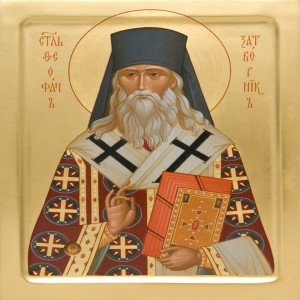
Tonight we concluded letter 75. This letter and those that follow all focus on particular temptations that Anastasia is facing as she approaches her decision to enter into the religious life. Theophan in Letter 75 focuses on the tricks of the enemy to dissuade her or throw her into despair because of the weaknesses, sins, and poverty that she sees within herself. His counsel to her is to allow these things to humble her but not to throw her into despair. Her endurance of the struggle is for the sake of crowns, he tells her; that is, the growth and perfection of the virtues.
In letter 76, Theophan begins to focus on the temptations that come from unbelievers. These are much more subtle, he warns her, and those who engage her will seek to cram a lot of worthless garbage into her head. They might be wise and clever in the ways of the world but underneath their words can be a malicious spirit that poses a threat to her faith. She must be willing to let what they say go in one ear and out the other and not purposely expose herself to the narrow mindedness and hard heartedness of those opposed to the faith. She must examine her own bewilderment and leave no trace of it within her mind and heart. Faith is a gift of God instilled within us by our very creation. It is older and greater than education and society. These things pass on knowledge to a new generation. However, we must understand that religious belief is part of every race because it is also the part of every man. In fact, “man is not man”, Theophan says, without it. To cast away our faith, to undermine it through neglect, is to distort and mutilate ourselves. He who does not have faith departs from the fundamental reality of who we are as human beings and in the process can make himself freakish on both a moral and psychological level. The perception and experience of reality is undermined by cutting oneself off from He who is Reality itself. Our response to this must be to embrace our faith fully and to allow it to transform us without any opposition; to allow the grace of God to inflame and purify our hearts.
---
Text of chat during the group:
00:05:42 FrDavid Abernethy, CO: bottom of page 289
00:14:16 Rachel: 😐
00:18:36 Anthony: comfort -> cum forte -> with strength
00:22:31 Anthony: I learned that at least in the time of the last Tzar and Rasputin, the Russian nobility were drawn to theosophy and other dangerous curiosities.
00:29:34 Eric Williams: And by being sucked into these unproductive battles, we risk behaving as the pharisee, rather than the publican.
00:29:57 Rachel: This is so good
00:30:23 Anthony: See HIllaire Belloc, "The Free Press"
00:33:05 Rafael Patrignani: Kierkegaard' s book: 'mortal sickness' talks about that process that leads to desperation
00:33:45 Anthony: Some "Science" is just philosophy or the occult in disguise.
00:34:51 Rachel: You're not alone for sure.
00:35:28 Philip’s iPhone: I’m working in a catholic high school and I can even relate !
00:35:30 Anne Barbosa: I also avoid having lunch with my coworkers
00:35:35 Eric Williams: Alas, too often science is distorted and contorted into scientism.
00:36:15 Erick Chastain: Eric W, my catholic scientist friends call it "teh science"
00:40:01 Eric Williams: “Tolerance is an attitude of reasoned patience toward evil … a forbearance that restrains us from showing anger or inflicting punishment. Tolerance applies only to persons … never to truth. Tolerance applies to the erring, intolerance to the error" - Fulton Sheen
00:42:32 Rachel: Wow.
00:43:59 Rachel: This is so timely and helpful. When we see ans sense a lack of the spirit of generosity in the other to engage in Truth, to seek Truth, we have more of an obligation to disengage. Quickly.
00:48:17 Rafael Patrignani: objectivity is an act of love and death to ourselves
00:50:11 Philip’s iPhone: Please remind me which number letter we are discussing?
00:50:27 Philip’s iPhone: Thank you !!
00:50:51 sue and mark: 76
00:58:57 Rafael Patrignani: nowadays I think culture is in a state worse than secularised.. it's increasingly against Christianity..
00:59:31 Anthony: Pierce v Society of Sisters
01:00:08 Anthony: the state tried to destroy Catholic schools precisely due to formation
01:02:24 Erick Chastain: sadly jack Kerouac grew up catholic
01:03:06 Erick Chastain: but ironically he led me to the faith (indirectly)
01:08:36 Eric Williams: Transhumanism is a mess
01:08:48 Rachel: "Face it, you're a moral freak!" okay..yeah I could see how that could be problematic.
01:09:38 Rachel: Because it gets filtered through the perspective of a mutilated sense of self that is not* rooted in Christ.
01:09:53 Eric Williams: Great. Now I'm hearing "moral freak" being sung by Rick James in my head. ;)
01:12:31 Rachel: Oh my goodness that is already happening.
01:13:33 Carol Nypaver: Frightening….
01:13:37 Rafael Patrignani: it's old like mankind but apostasy makes it worse
01:14:28 Rafael Patrignani: the lack of the spiritual anchor puts in danger the boat
01:14:51 Anthony: Khalil Gibran, "The Wise King" poem is about societal delusion
01:23:24 St. Stanislaus Kostka Religious Education: I am most turned off by the turn of some religious people pointing at others rather than asking for God’s grace that we ourselves become fire. As I think of the saints of renewal they seem to be more about the fire of the spirit rather than blame of others
01:24:39 Mitchell Hunt: Thanks Father David
01:25:26 Mitchell Hunt: Still uploading to YouTube afterwards?
01:26:10 Eric Williams: Easier to keep trolls and spammers out via Zoom, too
01:28:18 Rachel: Thank you!
01:28:23 Mitchell Hunt: Awesome appreciate the pod bean archive 👍
May 7, 2020
May 7, 2020
1hr 2 min
Tonight we continued our discussion of letter 12. St. Theophan strives to help this young woman see her dignity and destiny as a person made in the image and likeness of God. He lays a foundation by emphasizing the subordination of all things to the spiritual. The carnal, the intellectual, each have their place within our lives as human beings. St. Theophan, like the fathers before him, does not have a negative anthropology. In fact, just the opposite. He wants this young woman to be fully human, to be a real person. When the spirit no longer guides us our passions bring disorder to our lives and the fleeting happiness that we find in the things of this world quickly disappears.
In letter 13, Theophan begins to address Anastasia about things that initially seem out of context. But in reality he is building up on the foundation laid in the previous letter. He simply asks her what he should wish for her on her name day. He begins by wishing her good health and in doing so establishes this as a natural good for us as human beings. We truly experience the pain of its lack or when our health diminishes overtime.
He then wishes her happiness. He uses it as a prelude to asking and defining what happiness is. Everyone has their differing view. There is a definite happiness that comes through worldly things, from the carnal and the intellectual. However we can get caught up in these things and they can become a kind of opium for us. They offer a happiness that is passing or an illusion the covers the struggle and suffering of heart that we experience in this world. We are made for God and yet we are embattled and struggle with our own passions or temptations from without afflict us. True happiness, he tells her, is to be found in the spiritual life; for it is this life alone that endures beyond the grave. Even now God allows us to taste the sweetness of the invincible hope and joy He alone can offer.
Apr 30, 2020
Apr 30, 2020
1hr 17 min
We continued reading and discussing the 12th letter of St. Theophan the Recluse to the young Anastasia. He works very hard to show her that the illness that we struggle with is universal but it is also something that is willfully contracted. We all act in an unnatural way when we fail to subordinate the intellectual and carnal aspects of our being to the spiritual. Theophan makes it clear to Anastasia that there is nothing inherently sinful or evil about the intellectual or carnal but sin comes into play when they take supremacy over life in the Spirit and so make the self and our desire idols. We become less than human.
When we give ourselves over to the thoughts and desires associated with these aspects of ourselves we are easily drawn into sin and it can quickly drag us down like a whirlpool. Often it is very difficult to overcome such sin when it becomes habitual, or becomes a passion. In fact Theophan tells the young woman that sometimes we can remain fixed in the passion permanently.
However, Theophan assures Anastasia that even the most dedicated individual struggles with irrepressible thoughts. One should not become disheartened or despondent in the struggle. Anastasia has already made the first step in acknowledging the illness and the need for healing. What is most important now is that she guards her virtue and that she remains ever vigilant in subordinating all things to the spiritual life.
--------
Referenced in the recording, the text offered to the group from Fr. John (Ivan) Chirovsky by way of chat during the group is copied below:
Generally speaking, there is the western Christian definition, for example CCC 1773, where “passion” is a morally neutral concept. In reading St Theophan we need to remember his background wherein there is Eastern Christian definition, for example COP 795, where “passion” is always a vice, one of the capital sins - something that is cancerous and death bearing to the spiritual life. St John Climacus was of the opinion that each of the passions was originally something that God made as good and our sin perverted its purpose. Anger was given that we may hate the evil one and sin, but we use it to hate one another. St. John of the Ladder was of the opinion that only akedia had no good origin with God.
COP is Christ Our Pascha the official catechism of the Ukrainian Greco-Catholic Church.
In the East, all sin is missing the mark, and so death-bearing, we do not distinguish between mortal and venial sins.
The link to the English version of COP is available for reading online on the St Josaphat Eparchy's web site. You can also purchase it there.
In the East we also distinguish stages from getting from a thought to a passion. Search the internet for “The Struggle With Passions”, by I.M. Kontzevich. COP has a simplified version in paragraphs 790 and following. These stages of temptation are provocation, conjunction, joining, struggle, habit and finally passion. Technically, sin is born somewhere between conjunction and joining.
Here is a short summary of Kontzevich's description: In “The Struggle With Passions”, by I.M. Kontzevich,Also COP, 790, we read:
1. PROVOCATION (SUGGESTION) прилог, приложитиCOP, 791By impression, memory or imagination a thought, if it is not invited consciously and voluntarily, and if a person is not negligent about it, presents itself to us. This is the touchstone for testing our will, to see whether it will be inclined towards virtue or vice. It is in this choice that the free will manifests itself.
2. CONJUNCTION (sochetanie-поєднання) and 3. JOINING (slozhenie-складання) In COP, 792…2 and 3 are called (internal conversation)In short, the thought is conjoined to the feeling and they in turn are joined to the will.The thought produces a feeling. This determines whether the thought stays or leaves. If our feelings do not “hate” the thought but “like” the thought, the thought then enters into our consciousness. We begin paying attention to it. We begin delighting in it. AT THIS POINT there is a conjunction-поєднання between the thought and me. But sin does not yet exist. In order to cut off the sequence of notions, to remove it from my consciousness, and to terminate the feeling of delight, I need to distract my attention. I must actively and firmly resolve to rebut the images of sin assailing me and not return to them again. But, if I become inclined to act upon what the thought tells me and to get the satisfaction of partaking of it, then the equilibrium of my spiritual life is DESTROYED. My willpower is now cooperating with the thought. This is called: JOINING-складання. “This state is already "approaching the act of sin and is akin to it" (St. Ephraim the Syrian). There comes the willful resolve to attain the realization of the object of the passionate thought by all means available to man. In principle, the decision has already been made to satisfy the passion. Sin has already been committed in intention. It now remains to satisfy the sinful desire, turning it into a concrete act.”
4. STRUGGLE Christ our Pascha: 793: “A thought that has penetrated the heart through conversation is difficult to dismiss. A person cannot be rid of it without struggle and effort. The Word of God and prayer assure victory in this battle” Kontzevich: “Sometimes, however, before man's final decision to proceed to this last moment, or even after such a decision, he experiences a struggle between the sinful desire and the opposite inclination of his nature”.
5. HABIT- звичка, (Assent-згода, зволення)Christ our Pascha: 794: “acceptance of an evil thought, which is equivalent to defeat in battle. By making an evil thought one’s own and deciding to make it a reality, a person has already sinned, even if the evil intention is not [sic: be] acted upon.”Kontzevich: there is still “an unstable vacillation of the will between opposing inclinations” and “a sinful inclination has not yet deeply penetrated man's nature and become a constant feature of his character, a familiar element of his disposition, when his mind is constantly preoccupied with the object of the passionate urge, when the passion itself has not yet been completely formed.”
6. CAPTIVITY (Passion-пристрасть) Christ our Pascha: 795: “The final stage is the actual passion. This is a state of captivity that results from sinful activity. A person given over to passion experiences a constant inclination towards evil. The inclination can become so powerful that a person loses the strength to resist, becomes addicted to evil, and a slave to passion.”Kontzevich: “It is no longer the will that rules over sinful inclinations, but the latter rule over the will, forcibly and wholly enticing the soul, compelling its entire rational and active energy to concentrate on the object of passion. This state is called captivity (plenenie-полон). This is the moment of the complete development of a passion, of the fully established state of the soul, which now manifests all of its energy to the utmost.”
Apr 24, 2020
Apr 24, 2020
1hr 11 min
*PLEASE NOTE: Due to a poor internet connection that resulted in choppy audio, the first 20 minutes of the recording were edited out.*
In our first group on The Spiritual Life by St. Theophan the Recluse, we began by looking at his 12th letter to the young woman Anastasia. He firmly emphasizes the supremacy of the spiritual in her and our lives. Our life in Christ and the pursuit of holiness must pervade all that we do. We must keep our lives ordered and directed to the eternal. In so far as we subordinate the spiritual to the intellectual and carnal aspects of our nature we cease to be human.
The proper use of freedom and self-consciousness are the two elements of our lives that must be closely guarded. It is our negligence in this regard that makes us stand guilty before God. Furthermore we must not be under the delusion that we move with equal ease up and down the degrees of life. In an instant, the choice for and elevation of the carnal brings a fall from the graced life. However, the pursuit of purity of heart and the fruit of Ascetical discipline takes many years. There is no resting from the spiritual life.